


This easy orange juice turkey brine is my secret to a juicy, flavorful Thanksgiving turkey. It uses orange juice, brown sugar, fresh oranges, rosemary, and warm spices like cinnamon and star anise. It takes about 10 minutes to mix, and you can make it a day ahead. The salt keeps the meat moist. The orange juice and spices add a bright citrus flavor and a cozy holiday aroma without making the turkey taste sweet.

If you’re hosting this year, this citrus turkey brine takes one big worry off your list. Mix it Tuesday, brine the turkey overnight, and it’s ready to roast Thursday morning.
Below I’ll walk you through exactly how much salt to use (Morton vs. Diamond Crystal matters!), how long to brine a turkey by size, and how to keep it safely cold the whole time.
Why brine a turkey in orange juice?
The purpose of a brine for a turkey is two-fold; first, to infuse juciness to the meat. This is the main job of the salt in any brine. The second purpose of the brine is to add flavor to the meat. This is what the orange juice, brown sugar and spices are for. Don’t worry – the meat will not take on sweetness. The flavor will largely come from the spices, with just a hint of citrus from the oranges. For this, and any other brine recipe, the salt to sugar ratio is 2:1.
What do I need to make a turkey brine?
For this citrus turkey brine you’ll need the following ingredients. Note that I’ve linked these ingredients to Target (affiliate), should you need to do a quick, same-day ingredient pick-up. Target has same day pick-up, drive-up and even delivery, where they do the shopping for you.
- Orange juice – any bottled orange juice from the refrigerated section of the grocery store will work.
- Kosher salt – I recommend using kosher salt for any turkey brine. Table salt can sometimes result in a metallic flavor, which can definitely ruin the flavor of a turkey.
- Brown sugar – Brown sugar will give the brine a nice richness, but will not make the turkey overly sweet. Feel free to use either light or dark brown sugar.
- Peppercorns – whole peppercorns will add a great flavor dimension to the brine.
- Fresh rosemary sprigs – fresh rosemary is wonderfully aromatic, and will provide a great herby flavor to the brine. Buy extra for garnishing the roasted turkey – it will smell amazing!
- Ground sage – ground sage will also provide a nice herby flavor. It’s an ideal herb for any poultry recipe.
- Whole cloves – whole cloves will add a wonderful flavor to the brine. Be careful – just a few cloves will go a long way. No need to add extra.
- Star anise – star anise is another spice that will go a long way with flavor. You’ll need just a few of these beauties to add a great flavor dimension to the brine.
- Whole cinnamon sticks – cinnamon sticks will add a mild spiciness to the brine without overpowering the flavor.
- Garlic cloves – fresh garlic cloves will bring a great complimentary flavor alongside the cinnamon, cloves and anise.
- Oranges – fresh oranges will be slices and simmered in the brine. The orange slices will add a great citrus flavor to compliment the brine.
Materials & Supplies Needed to Brine a Turkey
- Brining bag – make sure you’re not buying a roasting bag. A roasting bag is made of much thinner plastic and won’t hold up to the weight of the liquid and the turkey. It will likely spring a leak! Make sure to get a brining bag which is made of thicker plastic and build to withhold the weight of the turkey and gallons of liquid.
- Stock pot – any stock pot or Dutch oven will do. You’ll need this to bring your brine to a simmer on the stovetop.
- A roasting pan – I actually prefer a disposable turkey roasting pan, especially when I’m making Thanksgiving dinner. It’s makes the clean-up much easier, as I dispose of the turkey carcass and any unwanted remains all in the pan.
For exact ingredient amounts and full recipe instructions be sure to scroll down to the bottom of the post for the recipe. Thanks!
How much salt for turkey brine (Morton vs Diamond)
Here is what I would recommend you use for salt for this turkey brine:
| Brand of Salt | Amount Used |
| Morton Kosher Salt | 1 cup / 240 grams |
| Diamond Crystal Salt | 1 3/4 cup – 2 cups |
For best results, I do recommend using Kosher salt over regular table salt. Some people have commented that table salt will leave a slight metalic aftertaste in the meat, however, I’ve never experienced this in over a decade of brining turkeys. Regardless, if you are buying salt for your turkey brine, choose a Kosher salt.

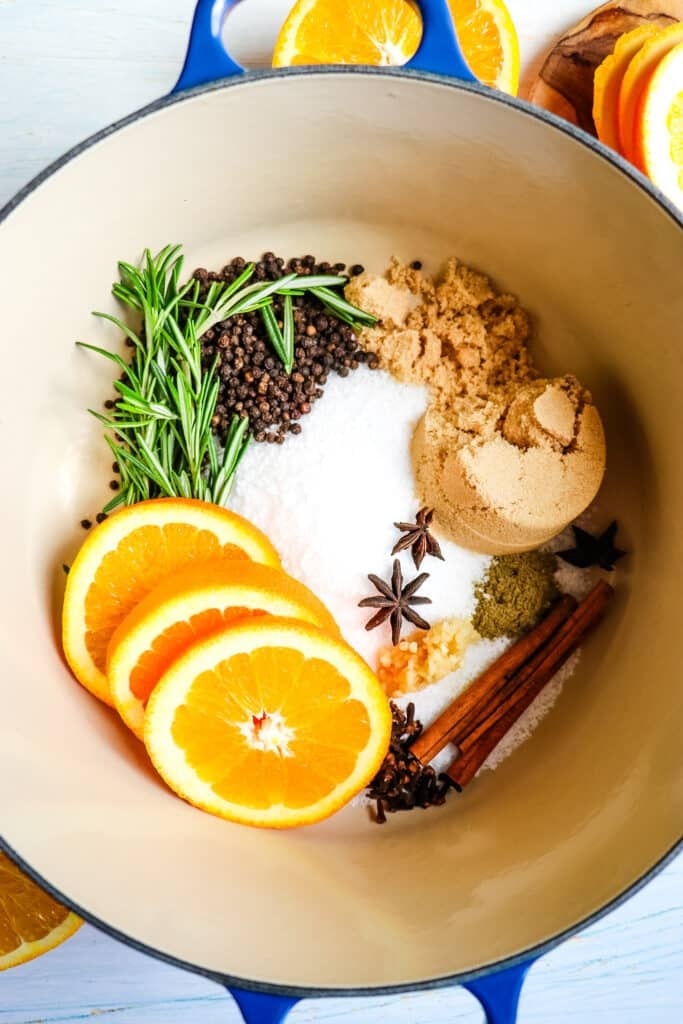
How do I make a turkey brine recipe?
To make a turkey brine, start by bringing out a large Dutch oven or stock pot. Add the salt, brown sugar, peppercorns, rosemary, sage, cloves, star anise, cinnamon sticks, garlic, orange slices, orange juice and water to the pot.
Stir the ingredients and heat over medium heat. Stir often to help the salt and sugar dissolve into the liquid. Bring the ingredients to a low boil, then remove the brine from the heat. Let the brine sit and come to room temperature.
Once the brine has cooled completely and is at room temperature, it is then safe to add to a raw, thawed turkey.
Note: we do NOT recommend adding a hot brine to a turkey. We also don’t recommend adding a hot brine to a frozen turkey to help it thaw.
Ingredient Substitutions and Recommendations:
- Substitute apple cider for the orange juice – check out my super popular recipe for Apple Cider Turkey Brine. It’s a Thanksgiving classic and thousands of people have raved about this recipe.
- Fresh sage in place of dry sage – often available in most supermarkets during the holidays, fresh sage is a great option in place of dried. Be conservative – just a few sprigs will go a long way.
- Swerve brown sugar substitute – if you’re like me and want to eliminate refined sugar, Swerve brown sugar substitute is a great alternative.
For exact ingredient amounts and full recipe instructions be sure to scroll down to the recipe at the bottom of the post. Thanks!


How do I brine a turkey?
Brining a turkey is surprisingly simple. Begin by placing your thawed turkey into a large brining bag. If you’re using a frozen turkey, make sure it is thawed and that you’ve removed the giblet bag and neck from the inner portion of the turkey.
Place the turkey breast-side down in the brining bag. This will help ensure the breast and thigh meat will be thoroughly submerged in the citrus turkey brine. The brine will help tenderize the meat, making it extra juicy while cooking.
Once your brine has simmered and cooled to room temperature pour the brine over the turkey and into the brining bag. If you have an extra large turkey, feel free to add more water to cover the turkey in the bag. Be sure to check out our post The Best Turkey Brine Recipes: Wet or Dry and How to Choose, where we go through different types of turkey brines, and give you an option for an simple turkey brine to get started.
Make Ahead Brine Timeline:
It’s always a great idea, especially if you’re hosting Thanksgiving, to cook in advance to save yourself time later. This turkey brine is no exeption. This brine recipe can be made the day before brining, so it is ready and cooled before you pour it over the turkey. Here’s a timeline that has worked well for me:
| Monday | Thawing Check – make sure your turkey is well on its way to fully thawing |
| Tuesday | Make the brine, let cool, and chill in the refrigerator overnight |
| Wednesday Morning | Take the turkey out, place into brining bag, pour prepared brine over turkey, and refrigerate. |
| Thursday Morning (Thanksgiving) | Take turkey out of brine, rinse and pat dry, prepare for roasting |

Wrap up the turkey and brine securely in the brining bag. Chip clips work well in securing the bag. (See photo above.) I like to sit the turkey in a roasting pan when placing it back in the refrigerator to chill. Should the bag spring a leak, the liquid will be contained in the pan.
Place the brined turkey in the refrigerator for 18 to 24 hours before roasting the turkey.
How Long to Brine a Turkey (By Weight)
Here’s a quick reference table on how long to brine your turkey by weight. Note that the brine times are just a suggestion. You can go over or under by a few hours and be completely fine. I don’t recommend brining a turkey any longer than 36 hours as the brine will begin to break down the protein fibers of the meat.
| Turkey Breast (4-7 lbs.) | 4–8 hours |
| Small Turkey (10-14 lbs.) | 12-24 hours |
| Medium Turkey (15-20 lbs.) | 18-24 hours |
| Large Turkey (20+ lbs.) | 24-36 hours |
With the medium and large sized turkeys (anything over 18 lbs.) I recommend adding some additional water to the brine in your brining bag. This will help give the turkey extra coverage by completely submerging the bird.
Smoking a turkey: time and temperature table
Are you thinking of smoking your turkey this year. Here’s a timeline of how long you should smoke your brined turkey based on temperature and weight:
| 225°F | Plan for 30 to 45 minutes per pound (roughly 6 to 7 hours for a 14-lb bird) |
| At 250°F – 275°F | Plan for 20 to 25 minutes per pound (roughly 4 to 5 hours for a 12 to 14-lb bird). |
| At 325°F – 350°F (Hot-smoked) | Plan for 12 to 15 minutes per pound (roughly 3 hours for a 12 to 14-lb bird) |
As always, be sure to check the internal temperature of the turkey to ensure it is done. Use an instant read digital meat thermometer to check at the thickest parts of the turkey – the large side of the breast, and the large side of the thigh. The internal temperature needs to read 165°F. Once done, be sure to let the turkey rest for 2–30 minutes before carving to let the juices settle and distribute into the meat.
Tips and FAQ’s about cooking a turkey:
A turkey can be brined anytime between 6-24 hours. The ideal time is 18-24 hours. I don’t recommend brining any longer than 36 hours, as the protein in the turkey will begin to breakdown and become grainy.
The brine amount is appropriate for almost all turkey sizes. The brine liquid will be a good amount for anything from a 10-20 lb turkey. Any larger and you may want to add some extra water.
Yes, a turkey breast can be brined before roasting. Simply place the turkey breast into the brine and refrigerate for 18-24 hours. Rinse thoroughly before roasting.
No, a brining bag and roasting bag are two very different products. A roasting bag is built to go into the oven and is a much thinner plastic. It is not meant to hold a large amount of liquid and will likely spring a leak. Instead, be sure to purchase a brining bag. This is specifically built for large amounts of liquid and able to withstand the weight of a turkey. It is much thicker plastic and is much more durable.
If you’re unable to find a brining bag, you can also use a cooler large enough to fit your turkey. If you are using a cooler, it is really important to keep your turkey cold while brining. Add ice to the cooler along with the turkey, and change it out often. Keeping the turkey cold is essential in preventing growth of bacteria which causes food poisoning.
Cook a turkey 10-12 minutes per pound. For example, if your turkey is 15 lbs, then you’ll need 180 minutes, or approximately 3 hours. To test for doneness, make sure to use an instant read digital meat thermometer. The temperature of the breast meat should be 165 degrees and the thigh meat should be at 175 degrees.
A turkey is best when cooked at 325 degrees.
The turkey is done cooking when the internal temperature of the breast is 165 degrees and the thigh is 175 degrees. For best results, use an instant-read digital meat thermometer.
The drippings shouldn’t be overly salty. However, if you would like to exercise caution, use half drippings, half water or chicken stock for your gravy.
Need some amazing side-dish ideas to go with your turkey? Here are some of our most viral side dish recipes:
- Mashed Potatoes with Boursin Cheese
- Balsamic Honey Brussels Sprouts
- Sweet Potato Casserole with Marshmallows
- Paula Deen’s Corn Casserole
- Ruth’s Chris Sweet Potato Casserole
- Everything Thanksgiving Stuffing
- Parmesan Mashed Potatoes
- Hasselback Sweet Potatoes
- Roasted Butternut Squash Medley
- Healthy Green Bean Casserole
- Roasted Rainbow Carrots
- Cranberry Fluff Salad
- Cranberry Citrus Salad with Pecans
- What to Serve with Mashed Potatoes
If you loved this turkey brine recipe, check out some of these other similar posts:


Want to Save This Recipe?
Enter your email & I’ll send it to your inbox. Plus, get great new recipes from me every week!
By submitting this form, you consent to receive emails from Delightful E Made.
Easy Citrus Turkey Brine with Orange Juice and Brown Sugar

Equipment
- Disposable Turkey Sized Roasting Pan These Reynolds Roasting Pans make for QUICK clean-up!
- Le Creuset Enameled Cast Iron Signature Round Dutch Oven, 9 qt. This is my GO-TO Dutch Oven / Stock Pot for just about everything!
- Turkey Brining Bags These Brining Bags are a MUST!
Ingredients
- 4 cup 1 quart orange juice
- 1 cup kosher salt
- 1/2 cup brown sugar
- 2 tablespoons whole peppercorns
- 2 tablespoons ground sage
- 3-4 fresh rosemary sprigs
- 1 tablespoon whole cloves
- 3-4 whole cinnamon sticks
- 2-3 star anise pods
- 3 cloves garlic minced
- 2 medium oranges sliced
- 1 gallon water
Instructions
- To a large stock pot or Dutch oven, add all of the ingredients; orange juice, salt, sugar, peppercorns, sage, rosemary, cloves, cinnamon sticks, star anise pods, garlic, orange slices and water.
- Heat over medium heat, stirring well to help the salt and sugar dissolve well into the liquid.
- Bring the brine to a boil, then promptly remove from heat. Let the brine cool completely to room temperature.
- Place thawed turkey (breast side down) into a brining bag, removing any giblets and neck from inner cavity. Pour the cooled brine over the top of the turkey, including all ingredients that were cooked in the brine (herbs, orange slices, cinnamon sticks, ect.)
- Seal the brining bag and secure with clips if necessary. Refrigerate the brined turkey for 18-24 hours.
- Once the brining is complete, remove the turkey from the brine and bag. Discard the brine and bag – do NOT reuse.
- Place the turkey into your roasting pan and thoroughly pat dry with paper towels. Lightly coat the outer skin of the turkey with olive oil or butter to create a nicely browned skin.
Notes


My mistake – I did not know kosher salt is coarse salt, so I used a cup of Himalayan (fine). It would be very helpful to add the weights of salt rather than the cup measurement because each salt size has a different volume/mass ratio.. I keep adding more juice and spices l, and am feeling like the apprentice wizard in fantasia.. it smells amazing tho!